
Since the European Accessibility Act (EAA) came into full effect on June 28, 2025, organizations have been scrambling to ensure that their websites and digital services offered on or to EU markets meet strict accessibility rules.
The first step on the compliance journey for public, private, and non-profit organizations is usually the website accessibility audit. It reveals which aspects of their website, app, or service are currently non-compliant. Audits help map crucial fixes and provide credible documentation for regulators and procurement.
In this article, we’ll answer key questions on accessibility audits under EU law, including what audits look for, how to carry one out, and how the report findings tie to other aspects of EU legislation like EN 301 549 and the Web Accessibility Directive. Whether you’re a site owner, developer, part of an organization’s digital marketing team, or a compliance lead tasked with devising a remediation roadmap, the article below is your all-in-one guide toward a structured audit process. Read on to learn more.
What is a website accessibility audit?
A website accessibility audit is a systematic review that looks for barriers impeding or preventing people with disabilities from using that particular website. It provides a benchmark against legal requirements and technical standards with actionable insights for remediation.
Both public sector websites and private organizations operating in or selling digital services in the EU must comply with provisions in the European Accessibility Act. A website audit maps current accessibility gaps in relation to European EN 301 549 and global WCAG 2.1 Level AA standards. The better the audit, the more detailed the report you’re going to get with prioritized issues, workable recommendations, and test evidence in the form of screenshots and assistive tech logs.
Why accessibility audits matter under the EAA?
Regulators in EU member states may demand an audit or inspect your website, especially if you’re a high-impact service provider or operating in the public sector. Professional audits act as proof that your organization is engaged in due diligence under the law. Audits also play a crucial role in helping you avoid enforcement risks and act as a systemic guide to compliance remediation. Unlike typical website accessibility testing services, audits offer a more comprehensive picture of the organization’s overall compliance with relevant regulatory standards.
What are the key areas covered by an accessibility audit?
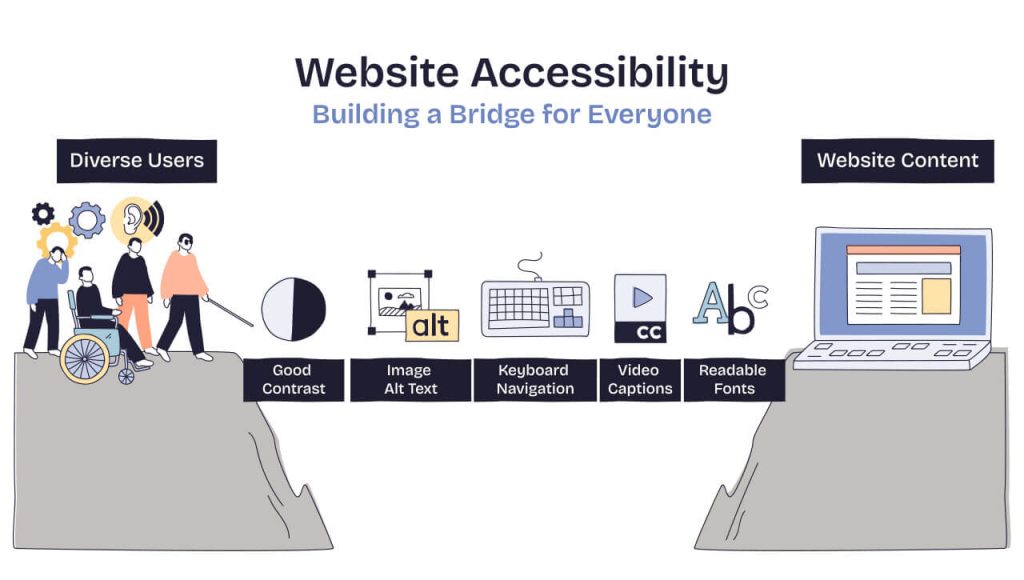
A website accessibility evaluation checks navigation, readability, forms, and multimedia content to ensure that the site aligns with the EU’s push for an inclusive web. As stated in the European Declaration on Digital Rights and Principles for the Digital Decade, “Technology should be used to unite, and not divide, people. The digital transformation should contribute to a fair and inclusive society and economy in the EU.”
Here’s a breakdown of typical audit focus areas:
Domain |
Key checks |
Why it matters |
|---|---|---|
Navigation & structure |
Logical headings (H1–H6), skip links, landmark roles |
Allows effective page navigation for screen readers |
Keyboard operability |
Visible focus indicators, all interactive items reachable via keyboard |
People with hand and/or arm mobility issues can’t use a mouse |
Color & contrast |
Text-to-background contrast ratios, non-color alternatives |
Helps users with low vision or color blindness use the site |
Images & media |
Alt text for images, captions & transcripts, audio descriptions |
Makes content perceivable by users with vision impairment |
Links & labels |
Descriptive link text, clear button labels |
Prevents confusion & supports screen reader use |
Forms & inputs |
Label associations, error messaging, fieldset/legend elements |
Facilitates filling of online forms for people using screen readers |
Dynamic content & ARIA |
ARIA attributes, live region announcements |
Makes interactive & dynamic sections accessible to all |
Error handling & feedback |
Clear error messages, instructions to recover |
Improves overall website accessibility & usability |
Assistive tech compatibility |
Test with screen readers, magnifiers, switch input |
Detects issues with real-world usability |

Manual vs automated audits
Website accessibility assessment includes both automated scans and human-driven reviews. While automated tools are used to detect technical errors, manual testing is great at pinpointing real-world accessibility barriers.
Automated audits
As their name suggests, automation tools automatically flag missing alt text, poor contrast, and code structural errors. However, automated website accessibility testing tools often miss usability issues that impact overall user experience (UX). This is where manual testing steps in.
Manual audits
Human testers use assistive technologies like screen readers and keyboards to mimic the end-user experience. They play an important part in a complete accessibility assessment and uncover practical issues that a tool like a real-time accessibility widget cannot detect.
What are the deliverables of a professional accessibility audit?
Hiring a professional website accessibility testing agency to conduct a robust website accessibility review does much more than just highlight existing problems and potential red flags. It also provides a structured plan with a clear outline of workable solutions with a prioritized set of guidelines to simplify fixes and guide you through the process. Findings are typically grouped by priorities and issue type, with explanations and code references attached. Prioritization serves to rank problems according to their relevance and salience as minor, moderate, and critical.
Typical set of deliverables includes:
- Executive summary with key findings, compliance gap overview, and clearly delineated high-level risks.
- Issue catalog with a URL, screenshot, description, and degree of severity for each failing element.
- Remediation guidance with step-by-step instructions, code snippets, and ARIA guidance.
- Standards mapping outlining appropriate WCAG & EN 301 549 clauses for each issue.
- Prioritization & roadmap of issues that need to be addressed first.
- Retest plan, pinpointing pages and modules that need revalidation.
- Compliance narrative that provides a valid context that an organization can use in governance, procurement, or legal defence.
How to perform a website accessibility audit?
To ensure a thorough review that leaves no piece of code or corner of your website unturned, professional accessibility audits adopt a step-by-step approach. Typical audit phases include:
- Test planning & scope calibration
- Automated scanning
- Manual testing
- Assistive technology review
- Evidence gathering
- Report generation phase
- Stakeholder review

Test planning & scoping
The initial planning phase defines targets, templates, and modules that are going to be audited, including homepage, service pages, online forms, checkout flow, etc. It determines the device types that fall within the scope of the review, from desktop and mobile devices to input peripherals like keyboards and customizable touch controls. Test scoping sets clear parameters for alignment with key compliance standards like WCAG 2.1 Level AA and EN 301 549, as well as regulatory requirements within the European Accessibility Act.
Automated scanning tools
Automated accessibility tools are used to deliver site-wide scanning at scale. Depending on the scope set during the test planning phase, automated tools can detect real-time compliance gaps, including low or overly high contrast, missing alt text, and missing labels.
Human-led manual reviews
Manual inspection takes a closer look at flagged breaches and non-compliance issues that automated tools can’t spot, including logic errors, reading order, and contextual deficiencies. Manual reviews mimic end-user interaction with the website to detect real-time barriers to access and an inclusive, user-friendly experience.
Assistive technology (AT) tests
Many people with disabilities rely on assistive technology to ensure a smooth experience in the online environment. Through ATs like screen readers, magnifiers, and keyboard-only navigation for mouseless browsing, individuals with disabilities can gain access to sites and functions that would otherwise be off limits. AT tests mimic the everyday user experience to validate the accessibility in real-world situations.
Collect evidence
Evidence gathering is an important aspect of both automatic and manual testing phases. Professional testers will take screenshots, record logs, transcribe interaction history, and note failures before presenting their findings. It’s important to record each issue carefully, note down exact URLs and problematic elements to provide a clear description of breaches, standard violations, and the severity of issues.
Report & prioritize
The last step of the website accessibility audit is the report. A high-quality audit report should be structured (summary, primary concerns, and a full list of issues) to streamline review and provide actionable remediation guidelines. Issues detected should be prioritized by severity, from critical, which require immediate action, to high, medium, and low. A detailed report will reference specific WCAG/EN 301 549 clauses in relation to appropriate website pain points.
Test review & validation
Once the test is submitted, it goes through an evaluation process where relevant stakeholders, including developers, product managers, the sales team, and designers, are invited to go over the document, validate the technical feasibility of the fixes proposed, prepare for remediation, and provide their feedback.
How do audit results map to EN 301 549 and WCAG?
We’ve mentioned that an efficient website accessibility assessment has to connect review findings with compliance provisions outlined in the EAA, and specifically with EN 301 549 clauses and WCAG 2.1 Level AA standards. Mapping out individual issues with WCAG and EN 301 549 helps frame the organization’s remediation path and provides legal compliance justification. Since the EU’s EN 301 549 standard harmonizes its guidelines with the WCAG 2.1 Level AA, accessibility requirements should be grouped by the functional features in the report.
Example:
If the page is failing the WCAG success criterion of being perceivable, operable, understandable, or robust for users with disabilities, it should be marked like this:
- WCAG 2.1 1.4.3 Contrast (Minimum), with the applicable EN 301 549 clause(s) attached and followed by a suggested mediation approach.
This type of clear mapping gives an organization’s remediation efforts a firm technical framework and legal footing.
How often should you repeat audits?
While it depends on the type and scale of organization in question, it’s highly recommended to conduct website accessibility reviews quarterly or ahead of major service releases and changes to core UI or website workflow. Keep in mind that digital products that change frequently often carry the risk that new features may violate accessibility regulations.
Regular audits are therefore necessary to ensure ongoing compliance, identify potential risk periods, and implement remediation solutions. Under existing EU laws, authorities may expect you to engage in monitoring and continuous review, so it’s important to embrace vigilance and stay compliant with automated weekly scans and real-time widgets.
Benefits beyond compliance
A professional website accessibility audit brings a few crucial benefits that go beyond ensuring compliance and avoiding costly legal issues. A thorough review can result in a significant improvement in your SEO performance, user experience, and overall brand reputation. Audits can uncover opportunities to make your website better placed in search engines, easier to use, and more respected by your customers and associates.
- SEO boost: Best practices in accessibility, like proper heading hierarchy, descriptive alt text, and clean code, all make it easier for search engines to crawl and rank your site, resulting in greater online visibility.
- UX improvements: Accessible design makes navigation easier, improves readability, and ensures smoother interaction between your presentation and the end-user, creating a more enjoyable experience for all.
- Brand reputation: A clear commitment to accessibility positions your brand as an inclusive, trustworthy partner, helping build customer loyalty and setting you apart from the competition.
For example, a retailer that invests in accessible design may not only attract more organic traffic but also win loyalty from customers who feel valued and respected. In short, accessibility audits pay off well beyond compliance—they make your site more visible, usable, and respected.

Who specializes in an insightful & actionable website accessibility audit?
A robust accessibility assessment of your website is not just a compliance checkbox. It’s a foundational service that identifies potential barriers for customers, offers clear remediation guidelines, and provides necessary documentation that holds legal weight under EU law.
Digital accessibility specialists at includeUs will conduct a thorough review of your website to pinpoint high-priority red flags, potential reasons for concern, map findings to relevant WCAG and EN 301 549 standards, frame everything in a legal context, and help you with actionable remediation suggestions.
Stop walking the fine line between costly, protracted litigation and a potentially devastating hit to your reputation on social media. Call us to schedule your free consultation, and we’ll go into fine detail to help you make sense of the importance of accessibility in today’s growing digital domain. If yo’re located in the UK, we’ve also prepared a comprehensive comparison of UK-focused accessibility services for you to check out. Embrace inclusion—contact us today!